How Alaska’s governor found himself on an Emirati falcon hunt
Mike Dunleavy, in a required gift disclosure, said he accepted a helicopter ride and overnight stay at a preserve. But his hosts won’t be getting any special treatment, he said after returning home.
When dignitaries visit Alaska Gov. Mike Dunleavy’s home state in the summer, their hosts often take them fishing for salmon.
But what does Dunleavy do as a visiting dignitary himself, traveling on official business to far-flung locales such as the United Arab Emirates?
Alaskans now have a glimpse of the red-carpet treatment afforded to their famously hunting-obsessed chief executive on a trip last year to the Middle East to solicit investment — courtesy of a legally required gift disclosure Dunleavy filed recently with state regulators.
In it, he shared details of an overnight traditional falcon hunt he took with the Emiratis — one that involved a journey by helicopter, a stay at a private camp and the avian pursuit of rabbits and a fluffy desert prey bird called a houbara.
“It reminded me of Alaska,” Dunleavy said in a phone interview this week. “Wide open spaces — kind of like western and northern Alaska, in terms of low-lying, rolling hills made out of sand.”
Dunleavy valued the hunting trip at $8,420, of which $5,000 was the estimated cost of the helicopter trip. In all, the governor and his wife accepted gifts valued at at least $54,000 in 2025, including travel to speaking gigs and events; luxury box access at a professional hockey game from the chief executive of Trident Seafoods; and a fall moose hunt supplied by a renowned Alaska guide, according to Dunleavy’s disclosure.
High-level state executives like Dunleavy are required to file the financial disclosures — which report gifts, income and other business affairs — in part to ensure that public officials are "free of the influence of undisclosed private or business interests," according to state law.
Dunleavy, in the interview, dismissed the idea that the free falcon hunt from his Emirati hosts would lead to favorable terms if the region’s wealthy investment funds ultimately choose to do deals in Alaska.
“‘Since we invited you on a falcon hunt, we’re wondering if you can give us a reduced cost in oil and gas?’ No — there was no ask for any of that stuff,” Dunleavy said, chuckling. “‘Dunleavy sells out Alaska for an invited falcon hunt.’ No, that didn’t happen.”
Dunleavy said his week-long trip to the Middle East was facilitated by the Trump administration’s ambassador to the United Arab Emirates at the time, Martina Strong, who previously attended an Alaska energy conference organized by the governor’s office.
Dunleavy, accompanied by officials from at least three state agencies, appeared at multiple events during the trip and met with representatives from Middle East airlines, ports and oil and gas companies. He spoke at an energy summit hosted by a global research company, and pitched investors on developments like Alaska’s partially state-owned LNG export project.
No major deals have been announced, however.
In the lead-up to the trip, Emirati officials, knowing Dunleavy’s love of hunting, contacted the governor’s office to invite him out to a hunting preserve, he said.
If you visit another place on business and get there early, he said, “they want you to partake in whatever the local culture is.”
“If you go to Louisiana, it’s going to be the Louisiana blues fest. If you go to Florida or you go to California, it might be golf,” he said. “If you go to the United Arab Emirates, they’re going to get excited if somebody they know is an outdoor person. Because they have a long tradition of raising falcons, for thousands of years.”
Dunleavy, who’s hunted bears and musk ox in Alaska, said the day-and-a-half long hunting trip entailed a night’s stay at a “modern tent compound,” which he acknowledged could be described as “glamping.” The hunt itself was from a pickup truck, he added.
“You put the falcon on your arm, and when they see the bird, you take the hood off the falcon; the falcon sees the bird,” he said. “They get the bird, they knock it out of the sky or they get it on the ground. They stay on it, and then the guys come over and they take the falcon off the bird — and that’s how they hunt.”
The houbara was taken back to camp, cooked and sampled by Dunleavy, who said it tasted good.
The experience also included a gift of a tailored traditional robe called a kandura, which Dunleavy acknowledged donning on the trip. But Alaskans may never get to judge the fit: Dunleavy’s office would not release any images from the governor’s trip in response to a formal public records request from Northern Journal.
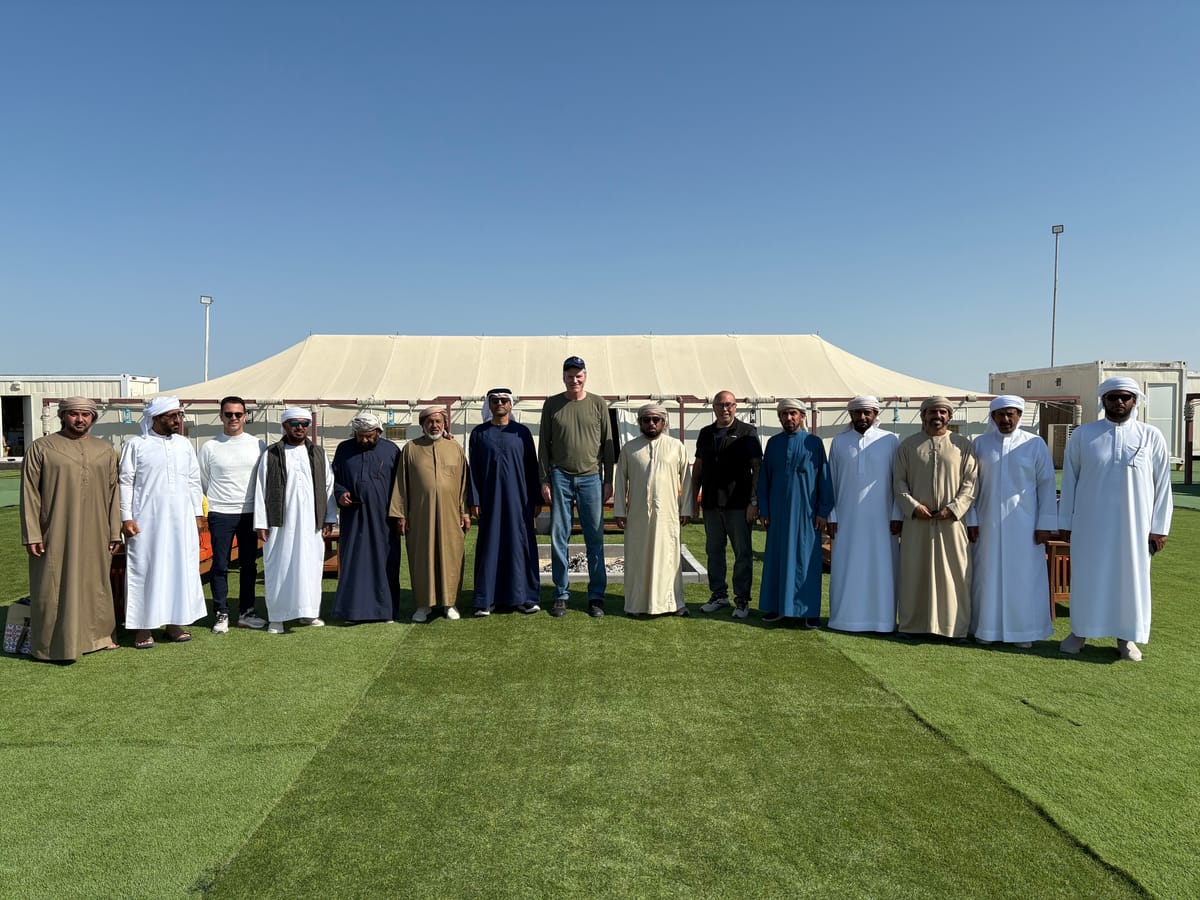
Later, after the phone interview, Dunleavy, through an aide, agreed to share a single photo. It showed him wearing jeans and a long-sleeved shirt outside a tent, standing on artificial turf with a group of locals — and no falcons in sight.
Asked why no photos were released in response to the earlier request under the Alaska Public Records Act, Dunleavy’s records access officer, Guy Bell, said the image shared by the governor was “personal,” and “not acquired or used for state business.”
“Therefore, it is not considered a public record,” Bell said.
If you like journalism like this, and you're not already a paid member, please consider a voluntary subscription by clicking the link above. If you're already a subscriber, thank you.