Opinion: Want to set your money on fire? Use it to boost Alaska’s false flag candidates.
Scott Kendall says efforts by incompetent Outside consultants are more likely to help the very candidates that they’re intended to harm — and in reality, the real-world impact will be nothing at all.
It’s Alaska political season and, once again, nonsense is in the air.
I, like most voters, have been buried under a quite literal avalanche of mailers, TV ads, emails and unwanted text messages from the dozens of candidates seeking our support.
There’s another phenomenon, too: nearly $2 million has been spent to boost and uplift U.S. Senate candidates who have literally no chance of prevailing.
You’ve probably never heard of most of these candidates, and some of them don’t even live in Alaska.
The strategy is as simple as it is stupid.
Partisans on the left are spending to raise the profile of right-wing extremists in the belief that their possible qualification for the general election will siphon votes away from the “normal” Republican running. Partisans on the right are doing the same thing, for the same reasons, to elevate fringe-y candidates from the furthest reaches of the left.
But here’s the thing: It does not work.
There are two big reasons these tactics have not, and will not, work to tip the election.
The first is the utter incompetence of the Outside operatives who design and implement these plans. Take, for example, the messages I’ve received personally. I’m a registered nonpartisan voter who was previously a longtime registered Republican.
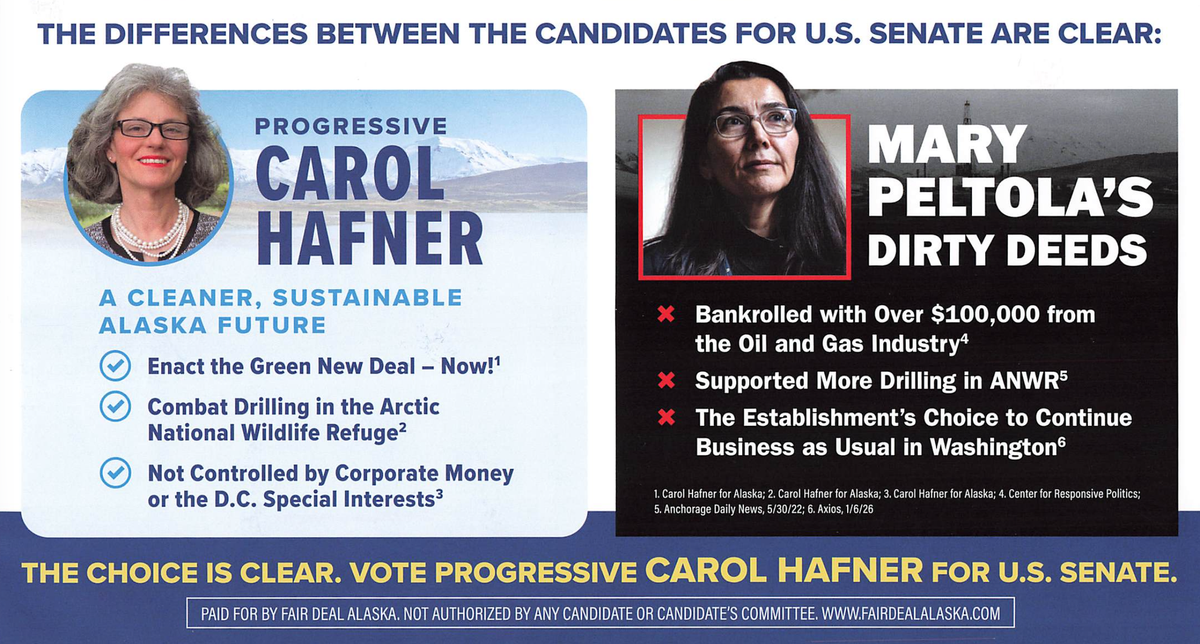
I have received conservative-aligned mailers pitching Democratic Outside U.S. Senate candidate Carol Hafner as superior to mainstream Democrat Mary Peltola — obviously seeking to hurt Mary by painting her as conservative.
Hilariously, one of the mailers argues that I should vote for Hafner because Peltola supports a “MAGA-lite agenda.”
It also says Peltola promotes oil development on Alaska’s North Slope, and supports Israel.
But the mailer was sent not just to far-left voters whose support for Peltola might be diminished by, for example, her reasonable pro-resource development positions. It was also sent to me, a Jewish former Republican who actually aligns with many the policies they attribute to Mary.Given that many Democratic-leaning Alaskans are moderates like me, these messages almost seem like they’re designed to fail in their purpose by actually boosting Peltola’s profile with swing voters. They’re hilariously incompetent.
Likewise, I have received left-wing mailers boosting goofball GOP U.S. Senate candidate Gerald Heikes as the clear choice for Republicans, over incumbent GOP U.S. Sen.Dan Sullivan.
At least Heikes actually lives here. But he’s still far from a credible candidate.
The pro-Heikes mailer that landed at my house starts off with a prominent quote attributed to him that “there are no Christians in the Democratic Party.” Very normal stuff. It then goes on to push a deranged narrative attempting to peel off hardcore Republican votes: that Sullivan, the incumbent, is a friend of the LGBTQ community and a supporter of Planned Parenthood.
But this tactic fails, too. Myself and many moderate, small-government Alaska conservatives strongly support the rights of LGBTQ Alaskans, as well as a woman’s right to choose: Two-thirds of Alaskans are pro-choice and more than half support same-sex marriage.
If the mailers had been sent only to the most extreme far right wing of the Alaska electorate, they might have made more sense. But they also, apparently, went to moderate voters like me. And, as with the Hafner mailer, the messaging seems like, if anything, it would help boost Sullivan in the aggregate.
In short, these efforts by incompetent Outside consultants are more likely to help the very candidates that they’re intended to harm — and in reality, the real-world impact will be nothing at all.
Keep in mind that this tactic was already tested and failed in the 2024 U.S. House race. Incarcerated out-of-state candidate Eric Hafner, a nominal Democrat, was boosted by GOP-aligned interests and qualified for the general election. The Alaska Democratic Party was so concerned by this tactic that they sued, and failed, in an attempt to block Hafner from the ballot. In the end, Hafner’s candidacy was much ado about nothing. In the first count of ranked choice preferences, Peltola trailed Republican Nick Begich III by more than double the number of votes Hafner received. In fact, the other general election candidate, far-right Alaska Independence Party member John Wayne Howe, received four times the number of votes that Hafner did.
In short, this much-feared “same party” candidate had virtually no impact, and certainly not a decisive impact, on the race.
This brings us to the second reason that boosting false flag candidates is unlikely to unfairly skew our election results: Alaska’s ranked-choice general election.
In addition to an open, all-candidate primary and a ban on Dark Money, our election system utilizes ranked-choice voting in the general election. The ranked choice system means that even if a voter is tricked into voting for one of these fringe candidates, if they truly want to support a candidate from a specific party, they can rank them, plus their next preferred choice.
That means fewer, if any, votes will be lost because of confusion.
At the end of the day, voters in Alaska are smarter, and much more savvy, than these Outside consultants give them credit for. Who can forget that in 2010 they figured out how to write-in “Lisa Murkowski” — re-electing their preferred Republican U.S. Senate candidate even though her name wasn’t even on the ballot.
For those who want to vote “strategically” in the upcoming primary, my suggestion is very simple.
The most strategic thing you can do is just vote for the viable candidate who is your favorite, or who you believe will bring an important issue or perspective to the race. Don’t engage in some outlandish bank-shot by supporting a fringe candidate whose views you revile in response to a misguided attempt to hurt another mainstream candidate.
Doing so will actually hurt the prospects of the candidate you most prefer — because the thing about bank-shots is that they can sometimes ricochet back and hit you right in the face.
Scott Kendall is an attorney in private practice in Anchorage. He’s worked for several members of Alaska’s congressional delegation and was chief of staff to Alaska’s governor.