A federal mining inspector wanted to investigate a Fairbanks property. Then, a state trooper called.
A legal dispute reflects a new twist to longstanding tensions between Alaska's small-scale miners and federal regulatory agencies.
A few days after a federal officer showed up at a property near Fairbanks to conduct a mine safety inspection, his boss’s phone rang.
The Alaska State Troopers were on the line.
“At this time, you’re being trespassed from that location,” trooper Riley Moss told the federal mine safety official, Jarrod Towne.
“You can’t do that,” Towne responded.
Towne works for the Mine Safety and Health Administration, or MSHA, the federal agency tasked with enforcing the nation’s mine safety law. Agency inspectors are authorized, by law, to make unannounced visits to any mine in the U.S., no matter how small.
But the property owners, Sheldon and Janne Maier, had told the troopers they were not actually mining, and they had reported Towne for trespassing on their private land, Moss said.
“That’s what they want,” Moss told Towne. “So, I’m doing my job.”
The conversation occurred last September and was captured by a recording recently obtained by Northern Journal through a public records request.
It’s part of the backdrop of a new lawsuit filed by the Trump administration against the Maiers’ business, Alaska Goldmine — the federal government’s second legal action against the Maiers in four years. And it marks a new twist in a long history of feuding between the state’s small-scale miners and federal regulatory agencies, which are often accused of overreach in rural Alaska.
In the past, Alaska politicians have sided with miners frustrated by what they describe as heavy-handed enforcement by federal agents. One particularly high-profile incident occurred in 2013, when agents with guns and body armor arrived unannounced in the Interior hamlet of Chicken to check mines for water quality violations.
This time, a state law enforcement agency took the unusual step of intervening on a property owner's behalf during a dispute with federal safety regulators.
Alaska State Trooper Riley Moss trespassed federal Mine Safety and Health officer Jarrod Towne from a Fairbanks property. (Alaska Department of Public Safety)
Legal and mine safety experts told Northern Journal they had never heard of a case where local or state law enforcement attempted to bar an MSHA official from a property.
“One should reasonably expect that a state officer attempting to interfere with the exercise of a federal officer doing his duty is likely to result in legal challenge,” said J.P. Tangen, a Washington-based mining lawyer and former president of the Alaska Miners Association.
A spokesperson for the Alaska Department of Public Safety, which oversees the troopers, declined to provide details about the incident, citing the agency’s “effort to not interfere with ongoing civil litigation.”
But the spokesperson, Austin McDaniel, said in a prepared statement that, in effect, the trooper followed standard protocol — and the matter is now before the courts, beyond the department’s jurisdiction.
“Troopers handled this property dispute and request for trespass as we would any other dispute, and no special actions were taken,” McDaniel said. “The best practice for the two involved parties to resolve this is in civil court.”
Near the end of the call with Towne, Moss suggested that the troopers ultimately would not stand in MSHA's way.
"I'm sure there are ways around [this], for you guys to do your job," the trooper said.
"Oh, there 100% is," Towne responded.
Longstanding tensions
Alaska’s 150 or so active placer mines are very different from the state’s seven big hardrock mines.
Placer mines are typically much smaller, both in physical size and revenue.
They target loose flakes of gold in creek beds or soil, rather than the rocky deposits that sustain the major mines, and they’re often run by families, with few or no employees.
After more than 20 years operating a placer mine in the remote Fortymile area in Alaska’s Interior, near the Canadian border, Sheldon and Janne Maier started mining for gold closer to home, near Fairbanks, about a decade ago.
They operated there, not far from the site of the original gold discovery at Pedro Creek that led to the creation of Fairbanks, for several years. Then, federal mining regulators showed up.
Towne, the MSHA inspector, first visited the Maiers’ site in 2022, following up on an anonymous complaint of unauthorized mining, according to legal documents reviewed by Northern Journal.
By law, Towne’s agency is required to inspect placer mines to ensure compliance with the federal Mine Safety and Health Act, which Congress passed in 1977 to reduce miner injuries and deaths across the country.
When Towne visited the Pedro Creek mine in 2022, Sheldon Maier denied entry and, later, refused to allow an inspection to proceed, Towne testified in court. The inspectors ultimately issued 17 citations — including for broken bulldozer windows, missing traffic signage and a lack of flotation devices near water — and some $8,000 in fines.
Maier, in an interview, painted a different picture, saying the officials landed on his property in a helicopter — an act that felt like intimidation, he added.
“I come out to the mine site, and there's a helicopter parked next to my wash plant sitting there on my mining spread, with two inspectors walking around,” Maier said.
Maier pulled out his phone to record the encounter, he said, and one of the inspectors “got angry and started yelling” at him.
A federal judge ultimately ordered the Maiers to allow federal inspections, and barred them from mining until they implemented a safety training program approved by MSHA.
The couple could not afford an attorney to pursue a legal fight, Sheldon Maier said. They told the court they would cease mining on the property.
“I don't have the kind of resources to fight the government that has a building full of attorneys,” he said.
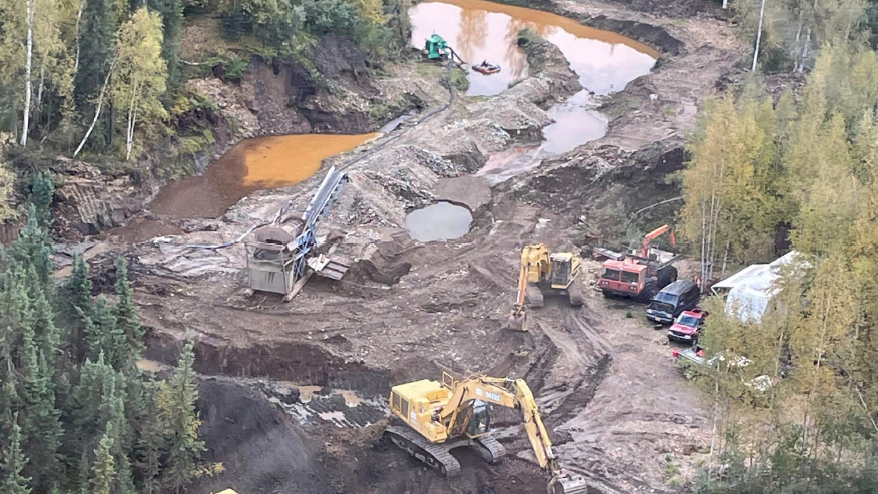
Then, last fall, MSHA conducted a fly-over of a separate property that the Maiers own a mile or two down the road. Officially, no mine was licensed there. But the agency observed what appeared to be mining activity, including active equipment and “signs of fresh dug earth,” according to legal documents that included aerial photos of large holes in the ground and earthmoving equipment.
Maier said he was using heavy machinery at the property to process gravel — “a few yards of material” — for his personal use.
The property, he said, is not a mine and should not be subject to inspections under the federal Mine Safety and Health Act.
“All I'm doing is trying to develop my property and develop my house where I live,” he added. “I'm not selling anything. I'm not marketing anything.”
MSHA is now asking a federal judge to allow the agency to inspect the property.
A recording of a call between a state trooper and Janne Maier regarding an MSHA official accused of trespassing on the Maiers' property. (Alaska Department of Public Safety)
A “vital” role
The dispute harkens back to the so-called Fortymile raids more than a decade ago, when a team of armed U.S. Environmental Protection Agency officers visited the Chicken placer mines to investigate reports of Clean Water Act violations.
That incident caused a firestorm among the state’s miners and elected officials, and even provoked a congressional hearing in Washington, D.C..
At the time, Sheldon Maier was president of the Fortymile Mining Association. Testifying at the invitation of Alaska Republican Rep. Don Young, Maier, wearing a flannel shirt, called the action an “unacceptable show of force.”
The state's mining industry, collectively, has also criticized MSHA’s enforcement tactics in the past.
In 2011, the director of the Alaska Miners Association, or AMA, described the agency as having “lost its way,” with a focus on “penalizing companies” rather than protecting workers.
Maier said he supports miner safety and believes regulations are necessary for big mines, but he doesn't think the same standards should be applied to mom-and-pop operations, particularly those without employees.
Given how different placer mines are from large lode operations, and given that they’re less common outside of Alaska, the realities of operating them “are often poorly understood by federal agencies,” said Deantha Skibinski, the current AMA director.
Regulations built around the nation’s large mining operations “can hit these mines very differently,” Skibinski added in an email, saying that the resulting “punitive environment” can push small mines out of business.
But Skibinski also described MSHA’s role in miner safety as “vital,” and said agency officials “should have every tool in their box to enforce when a situation of real danger is present.”
She declined to comment on the dispute between the Maiers and MSHA.
Nationwide, mining deaths and injuries have sharply declined since the mine safety agency was created in the 1970s, experts say.
In over 40 years of working with Alaska’s mining industry, Tangen, the attorney, said he has not seen an MSHA officer act with “malicious intent.”
But, he added, in many instances, the violations they cite “may seem to be minor in nature — in the context of an operation.”
Reporting like this takes time and money. Northern Journal's primary revenue source is contributions from readers. If you're already a member, thank you. If not, we'd be grateful if you'd consider a voluntary subscription.