This podiatrist spent $325 per vote in his bid to be Alaska governor. Here's how the other candidates did.
Independent Bill Walker, meanwhile, spent a mere $10 to win each of his 7,333 votes.
Northern Journal has merged with the Anchorage Press! Read our announcement and other information here, and support us with a subscription here.
Matt Heilala spared little expense on his gubernatorial campaign.
The Anchorage podiatrist, a Republican first-time candidate, largely self-funded his bid for governor, putting up more than $1 million in his own money.
Heilala’s campaign paid for ferry tickets in Ketchikan. Internet. Car washes. A helicopter tour of a port outside of Anchorage. AI software. Local honey and custom cookies. Business cards. Campaign apparel. A $2,800 table at a Jewish gala. A $2,300 stay at the Ritz Carlton in Washington, D.C. And tens of thousands more on consultants.
Once the votes were counted, however, Heilala claimed just 4,328 of them, or 2.6% of the electorate — earning him 10th place and the dubious distinction of least-effective spender in the 17-person gubernatorial primary.
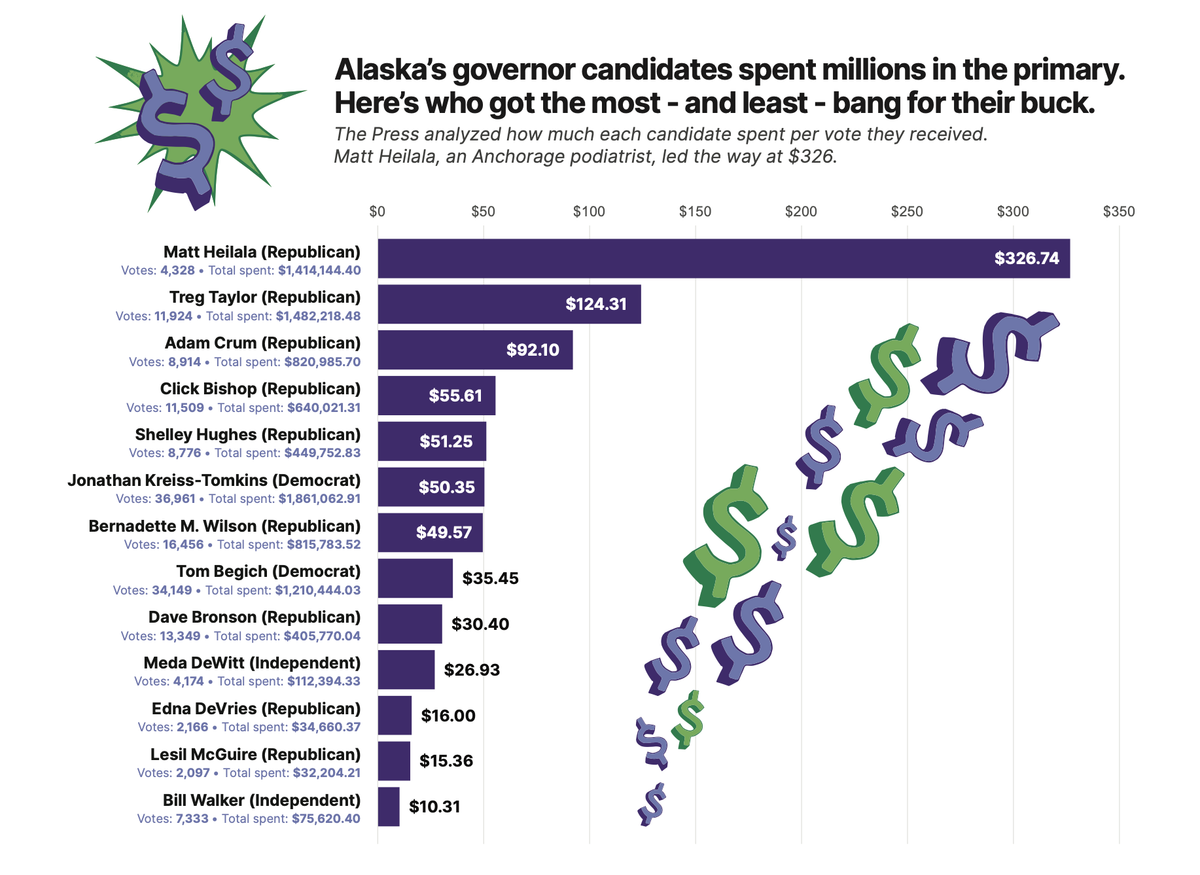
Heilala spent some $325 for each vote that he earned, according to an Anchorage Press analysis of the most recent campaign finance reports and vote totals.
That’s six-and-a-half times more than the primary election’s top finisher, Democrat Jonathan Kreiss-Tomkins, whose nearly $1.9 million in spending helped generate some 37,000 votes — a relative bargain of $50 for each one.
 Will Koeppen
Reached by phone, Heilala said he had no regrets, and that his campaign spending spree would not affect his quality of life.
“It was a little painful for us to do that. But we did have that money, and money is not meant to be stacked up and laid on. You need to live life and do things — and for me to pinch pennies in a campaign, in my position, would have been like, ‘Well, why am I even doing this?’” he said. “There's no shame, and we're happy with what we contributed.”
At the other end of the spectrum was Bill Walker, the independent former governor who mounted a late bid to return to the office he held from 2014 to 2018. (The Press limited its analysis to candidates who received at least 1,000 votes.)
Walker spent some $75,000 and won 7,333 votes, meaning that each one equated to about $10 in campaign spending. He used Alaska Airlines miles for some of his travel, recorded videos with a wireless microphone donated by one of his daughters and bought some of his radio ads himself, rather than through a marketing agency.
“We didn't do the TV stuff and plaster the state with signs and all that. We just focused on getting our message out,” Walker, who finished in ninth place, said in a phone interview. “We’re fiscal conservatives.”
Walker acknowledged that he likely also benefited from some name recognition from his four years as governor. But, he added, “that cuts both ways, too — you bring the good and the bad.”
Graphic by Zac Bentz for the Anchorage Press. Data for this piece was collected by Will Koeppen, a data scientist and graphics developer with deep Alaska ties. See more of his work at willkoeppen.com, and view an interactive graphic on gubernatorial race campaign fundraising that he made for the Anchorage Press here.