An Alaska candidate for governor sparked a backlash by taking AI employees’ money. But he says he’s the opposite of an AI candidate.
“I absolutely should have seen this coming,” said Democrat Jonathan Kreiss-Tomkins.
Northern Journal is merging with the Anchorage Press! Read our announcement and other information here, and support us with a subscription here.
Alaska hasn’t had a Democratic governor in a quarter century, since Tony Knowles left office in 2002.
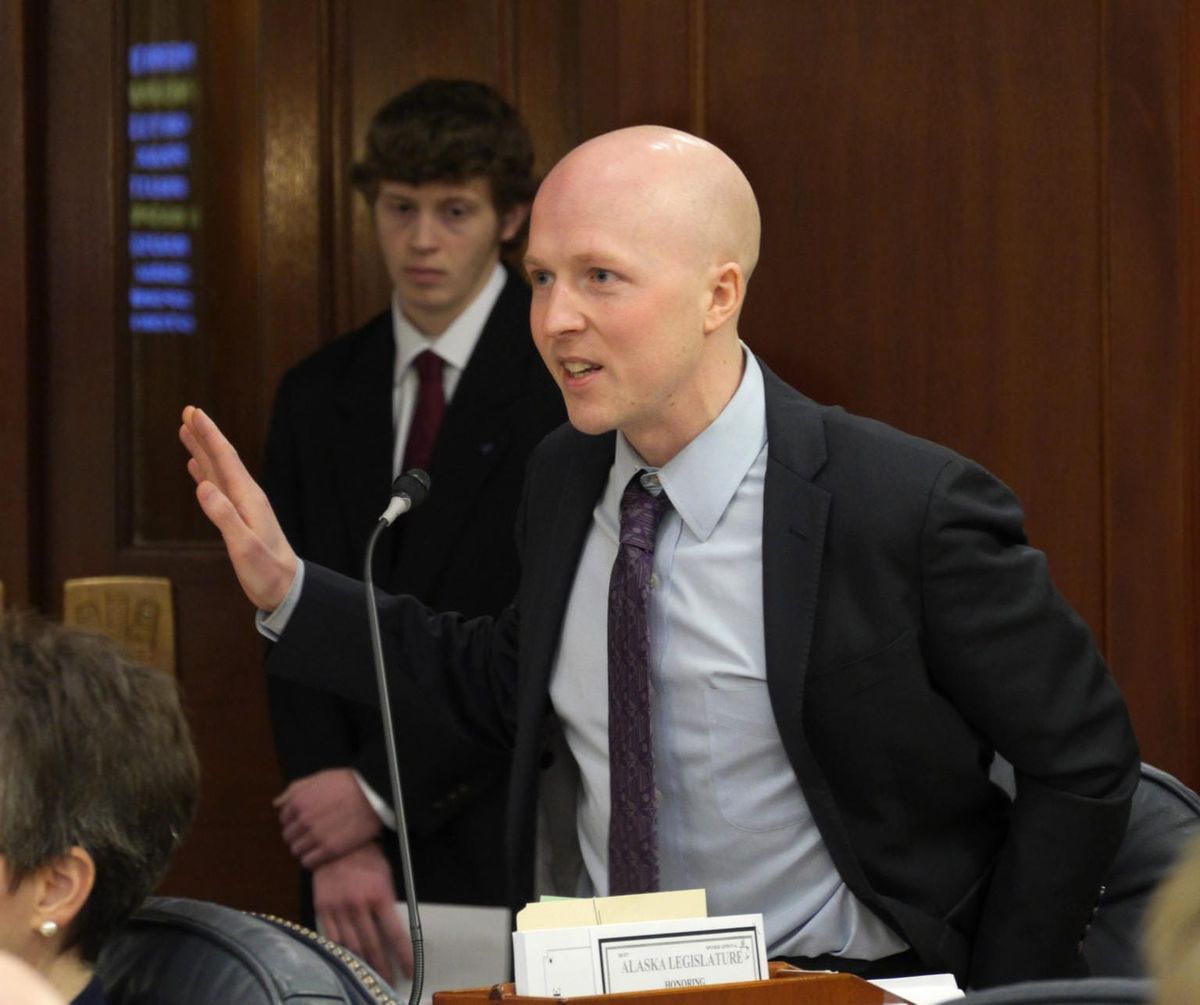
But Jonathan Kreiss-Tomkins, a Democratic former legislator from the Southeast town of Sitka, has shown he’s a credible candidate — at least in financial terms.
Last month, Kreiss-Tomkins reported a fundraising haul totaling $1.8 million, ranking him at the top of all 17 people running to be the state’s next chief executive.
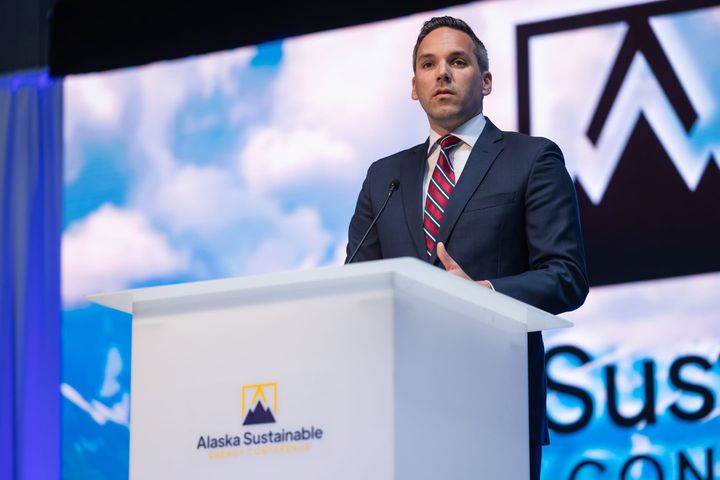
The source of a big chunk of Kreiss-Tomkins’ money, however, has drawn significant scrutiny: employees of the AI company Anthropic. Drake Thomas, an Alaska-raised Anthropic employee on the company’s safety team, donated $100,000 to Kreiss-Tomkins, and five of his colleagues gave a total of $272,000 more.
The AI industry cash generated newspaper headlines and critical posts from Alaskans who questioned whether the donations would make Kreiss-Tomkins vulnerable to influence by special interests. One cheeky social media meme depicted Kreiss-Tomkins hiding his face behind a wad of cash with the caption: “How was I supposed to know you guys wouldn't like my piles of AI blood money?"
Since then, Thomas has weighed in with an op-ed in the Anchorage Daily News saying he’s ”terrified by the extremely rapid pace of AI development,” and pointing out that Kreiss-Tomkins has proposed an AI policy that includes a moratorium on data centers. But others are still questioning Kreiss-Tomkins’ commitment to regulating the industry. So, the Anchorage Press called him to ask some questions.
The interview has been edited for clarity, and slightly condensed. We started by asking Kreiss-Tomkins about what he knows about Anthropic’s interest in expanding into Alaska, and how that relates — or doesn’t — to the employee contributions. We also asked Anthropic itself if the company is supporting Kreiss-Tomkins. Spokesperson Danielle Cohen responded: “Employees' donations are personal and not company-directed.”
Jonathan Kreiss-Tomkins: To the best of my knowledge, Anthropic has negative interest, less than zero interest, in Alaska. And in the social media chatter, there’s been conflation — it's obviously, like, individuals, and not the company (who donated). Although I think some people, naturally, maybe just don't even care about the distinction. And I kind of get that.
The broader background is: I harbor a lot of concerns about AI's potential, and quickly becoming real, impacts on the world as we know it. And I, for many years, have been in policy and professional circles with the people, nationally, leading the charge to try to create safeguards on the Wild West of this technology. I've gone to conferences, and I'm in these professional networks. The irony of it, with the perception versus reality, is these people are really some of the national leaders trying to ratchet down AI, and slow things down, and have, really, the most aggressive possible regulation.
Drake and some of his colleagues and peers — they've written publicly in support of a moratorium on AI development. So, I think the core issue is trust here. People don't know who these people are. They see ‘AI.’ They are understandably concerned. Hackles go up.
I think it was really helpful for Drake to just say, ‘Hey, this is who I am, and this is what I'm about.’ Even if you don't take him or his op-ed at face value, Drake and some of the other folks have long, public records advocating around really aggressive regulation. Which sort of is the opposite of what I think a lot of people were concerned about when they saw the initial report.
 Nathaniel Herz
Anchorage Press editor Nathaniel Herz: In any of your conversations with Drake or any of these other Anthropic employees who donated, did you make any commitments, or did they ask for anything other than that you be a proponent of aggressive AI regulation? Did any of them at all ask you to support measures that would boost Anthropic, or support AI investment in Alaska, for example?
Kreiss-Tomkins: Absolutely, emphatically no. Categorically. I don't know what other adverbs or adjectives to say, but absolutely not.
Herz: And you've made no commitments, and they've made no requests, of anything to further the industry in Alaska?
Kreiss-Tomkins: Correct.
First of all, no quid pro quos, period. But I think the reason we know each other, and the professional networks that we're in, they want to see AI regulation. They want the exact opposite of furthering AI investment in Alaska.
Herz: Have you met anyone from Anthropic’s executive suite? Can you also say that you haven't had any conversations with them about expanding into Alaska?
Kreiss-Tomkins: Correct. I've never spoken with, I know no one in Anthropic’s C-suite, and I would be absolutely shocked if they had any interest in Alaska. So, the answer is no.
Herz: Do you have any sense or understanding through your campaigning, or through your other work, that there is any corporate interest by the major AI companies in expanding into Alaska?
Kreiss-Tomkins: From what I know, it seems very unlikely that any of the major AI companies or labs have any interest in investing in Alaska. The only data center development I'm aware of is what I've read about in the news — like, on the North Slope — none of which, so far as I'm aware, are connected to the major AI companies.
 Nathaniel Herz
I still think there's legitimate public concern and reaction. My general orientation is, you don't build stuff and figure out the consequences later. You create a framework and a regulatory structure first that protects the public interest, and then stuff proceeds, if at all.
I had this on my website before the, sort of, furor over this. I support state regulation of AI, and I think it's kind of similar to other issues where the federal government has failed to act, and you have states that compact together. And the more states that compact together, behind a similar policy, the more it has a national effect to prompt a change in industry behavior.
Alaska is a small minnow, because we're only 730,000 people. But I followed California's regulation of AI pretty closely. I know the state senator who passed that legislation, and have spoken with his staff as they were doing it. And I would like to see Alaska effectively mirror that California legislation or something similar, because I think it just adds that much more weight to creating regulatory protections around AI — that otherwise don't exist because the federal government has failed to act.
Herz: What kind of reaction were you expecting when this information about your fundraising came out, and how did the response compare to what you were anticipating?
Kreiss-Tomkins: I think I failed to give full appreciation to the optics of this. Because, having known Drake and the work of these other folks for a while, it was like, ‘Oh, these are the good guys.’
I know that's reductive. But these are really prominent safety, security and regulation advocates. And because I have been closer to the subject matter for years, I didn't even really quite think, zooming out, if you're not close to the AI regulation space, how this would pretty obviously come off. And so, I was too close to the trees and not seeing the forest there. And quickly realized, for someone seeing this for the first time, this is going to create a very obvious reaction. Even though I know that the reality of what I believe and what I have worked on is more or less the exact opposite of that reaction.
But I should have, I absolutely should have seen this coming, more than I did.
Herz: Do you use AI?
Kreiss-Tomkins: A little bit. Not aggressively. I don't have a paid plan. But I used it yesterday, because I had a long list of names and I wanted to have them comma-separated, and just told AI to do it. But I wouldn't describe myself as a power user.
Herz: And it seems like you're not an evangelist for it?
Kreiss-Tomkins: Correct.
I definitely want to be very eyes-wide-open. Because I think this technology is changing the world and will change it more, potentially in ways that are hard for us to even anticipate. And again, that's where my concern comes in. It’s this kind of tricky balance, where you want to understand the thing in order to hopefully take constructive action around the thing.
Herz: Do you think, in 10 years, that this could be an industry that could in some ways actually benefit the state of Alaska, if done carefully? Such as with a data center, where the state or a municipality could derive some property taxes? And if it uses a resource that's not currently being used, like natural gas on the North Slope that’s not currently connected to the electric grid?
Kreiss-Tomkins: I need to learn more about the current proposals. I don't really see data centers, in and of themselves, as creating that much economic benefit.
I am much less familiar with data centers than I am with AI regulation. And those two are interrelated but fundamentally different things. My understanding on data centers is high (construction costs), very low ongoing jobs and economic benefit, but very obvious impacts. But also varying on location and context.
Herz: If you could do it over, would you still solicit and accept this money from Anthropic employees?
Kreiss-Tomkins: I don't know what to say. I would definitely think much harder, given the perception and optics challenges. I think I'm going to avoid support from any other Anthropic employees. I think that's a fair statement.
And also: We're in this super sucky campaign finance landscape — which I hate, and have worked as a legislator to prevent — which is, like, unlimited money. I've got one opponent who got — and I don't begrudge him this, because this is the awful rules of the road — $625,000 from two people. And a couple of other folks — and this would never be changed by campaign finance, but it still speaks to the awful dynamic that exists in money and politics — have self-funded as much as $1.5 million.
It’s just this arms race, and as a friend of mine said, you can't bring a butter knife to a bazooka fight.
Herz: You can't bring a dip net to a purse seine festival.
Kreiss-Tomkins: It sucks. Fortunately, I think it's going to get fixed in the primary election, with a ballot initiative (to limit campaign finance contributions). But here we are in this election cycle, and it's not fixed yet. So, yeah: You can't bring a butter knife to a bazooka fight.
Disclosure: Kreiss-Tomkins facilitated some early-stage meetings around the revitalization of the Anchorage Press. He has no involvement with the organization today.