A huge data center could rise on Alaska’s North Slope
The $500 million project could consume twice as much natural gas as urban Alaska’s grid.
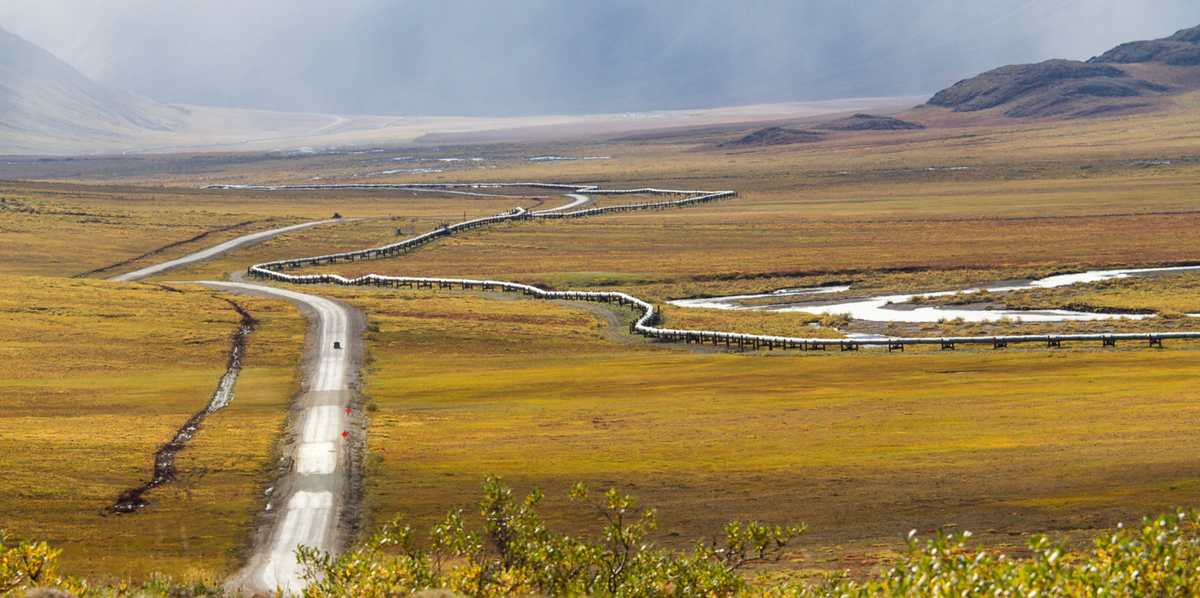
One of the largest data centers in the nation has been proposed on Alaska’s Arctic North Slope, where boosters say it could take advantage of abundant land, cold temperatures for cooling and a huge supply of natural gas for power.
The $500 million development would occupy an entire square mile with multiple buildings in a remote area off the Dalton Highway, some 25 miles south of the North Slope’s major infrastructure. That’s according to documents released this week by the state, which on Tuesday issued a preliminary decision to lease the property to the project’s operator.
A newly built pipeline would carry natural gas to fuel the data center’s power plant — which, according to the documents, could use more than twice as much of the fuel as urban Alaska consumes for electrical generation and home and commercial heating. The project could ultimately produce up to three gigawatts of power for its own use, making it competitive with some of the largest data centers under development in the Lower 48.
The company behind the project is Stak Energy, which last year proposed a far smaller project more narrowly focused on digital mining of cryptocurrency. It now says it plans to support "large-scale AI and cloud computing operations," including training of large-scale machine learning models and high-performance scientific and analytical computing.
 Nathaniel Herz
The company in November proposed its lease to the Alaska Department of Natural Resources, which subsequently published a notice to solicit competing bids. None came in, so the department is now proceeding with the leasing process, with a public comment period on the preliminary decision open through June 15.
Stak has not disclosed who would finance its new project, though it previously said it was raising money from Anchorage firm McKinley Alaska Private Investment.
Stak has expanded significantly in recent months, making a number of politically connected hires including Gov. Mike Dunleavy’s former natural resources commissioner, John Boyle, and a former special assistant at the natural resources department, Jim Shine.
The company’s founder and chief executive, Sparrow Mahoney, grew up in Alaska and attended Wasilla High School.
Stak officials declined to respond to specific questions about its proposal. But the company shared a prepared statement that describes itself as having “deep Alaska roots, built on decades of combined experience across the state’s energy and infrastructure landscape — and proud to help build Alaska’s next era of prosperity.”
The lease application, the company said, “reflects an important milestone for anchoring Alaska as America’s at-scale energy solution — a meaningful step toward bringing opportunity, jobs, and revenue home to stay.”
“Stak Energy is committed to responsible development, expanding opportunity, and contributing to a more diverse and resilient Alaskan economy," the company said.
Energy experts said that Stak’s lease application, released by the state, is thorough. But it also raises a number of questions.
One is how quickly the company can secure the natural gas-powered turbines that it would use to generate electricity. Rising demand for those turbines, prompted by the rush to build new data centers and the overall expansion of natural gas-fired power, is leading to manufacturing backlogs as long as seven years; Stak says it wants its initial operations to begin in 2028.
Then, there’s the question of where, exactly, Stak will get its natural gas supply.
Alaska’s North Slope oil fields contain huge deposits of natural gas. But historically, petroleum companies have almost exclusively extracted oil from those fields, as it’s more energy-dense and can be shipped down the 800-mile trans-Alaska pipeline; minimal infrastructure exists to move North Slope natural gas to market.
Companies presumably would be willing to sell gas to a project like Stak’s, according to Antony Scott, a former commercial petroleum analyst for the Alaska Department of Natural Resources.
But details of Stak’s land lease application makes clear that at the time it was submitted, the company hadn’t yet struck a firm deal for gas supply, he added. Stak says its gas pipeline could run anywhere between 25 and 90 miles, which implies that it could connect to any number of different petroleum fields on the North Slope.
“That means they don't have a gas supply,” Scott said.
Scott added, though, that the project’s remote location — and the fact that it wouldn’t connect to Alaska’s urban power grid and risk driving up demand and prices for electricity, like data centers have in the Lower 48 — help smooth the project’s path.
“The issue of data centers and the effect on normal humanity's electricity bills is causing real angst,” Scott said. On Alaska’s North Slope, he added, “we avoid all of that. You can just step into this friendly environment.”
Stak’s application and supporting material say its project has another leg up on Lower 48 developments.
Outside projects have faced increasingly strident opposition in response to their enormous consumption of water for cooling. The company says in its lease application materials that its North Slope location is a "crucial design advantage" because of an average annual temperature of 12F — allowing it to use air for cooling instead of depending on water.
Air cooling, the company says, is expected to reduce water consumption by 90% or more, "compared to industry norms." Stak isn’t proposing any formal use for the project’s waste heat for now, but it says that “potential applications” include keeping greenhouses warm or supporting aquaculture.
One comparative disadvantage for Stak: It would be powering its computer infrastructure with fossil fuels. Some technology companies with carbon emissions targets are making efforts to run their data centers on non-fossil energy like nuclear power, wind and solar, though other projects have also tapped into natural gas.
Stak, in its application, says it’s monitoring developments in technology that could allow it to capture and store its carbon emissions. But at least initially, a dearth of infrastructure and a lack of understanding of the region's geology for storing carbon are among the obstacles it faces, the company said.
Dunleavy’s administration, which has pushed to develop a data center industry in Alaska, has issued a preliminary, formal decision that the project is in the state’s “best interest” — a necessary step before it can issue the 50-year land lease that it’s currently considering.
The preliminary decision cites a peak construction workforce of 1,500 people, with some 60 permanent jobs that would be created by the project.
Stak will have to complete additional permitting before the project can move forward — namely, a federal Clean Water Act authorization needed to create the company’s gravel pad that will elevate its power plants and computer systems at least five feet off the tundra.
The project would require an enormous amount of gravel — some 7 million cubic yards worth, according to the state leasing documents.
That’s nearly twice as much as petroleum company ConocoPhillips is authorized to use for its big Willow oil project, Stak says.
If you value public interest journalism like this, please consider a voluntary paid membership to Northern Journal. If you're already a paid member, thank you.